


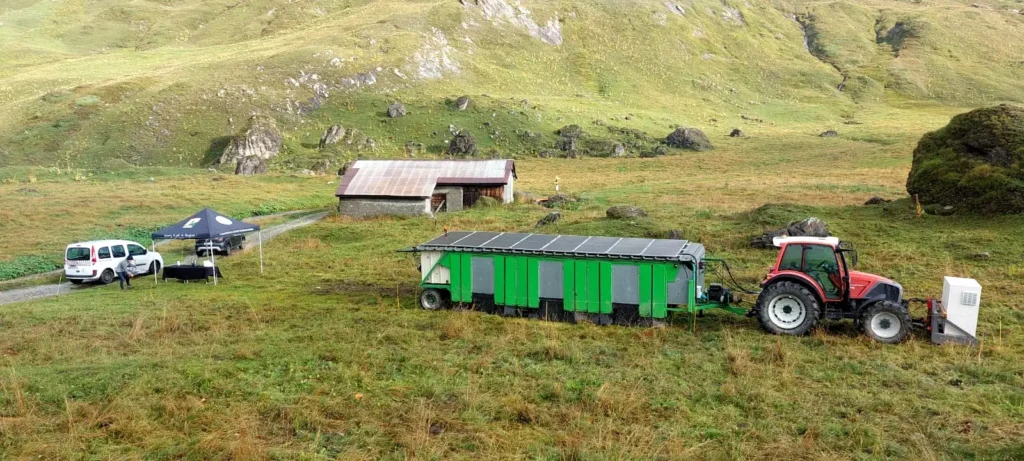
On September 10, 2024, the Beaufortain Dairy Cooperative, in partnership with the Alpine Economic Society of Savoie (SEA73) and EDF, will inaugurate three prototypes of mobile milking machines powered by photovoltaic panels. The inauguration will take place in the presence of the project’s funders (Region, Department, Crédit Agricole, Arlysère) and technical partners.
These prototypes of mobile generators, powered by solar energy, are already in service in the alpine pastures of Beaufortain and Val d’Arly. Since the summer of 2023, two farmers from Beaufortain have been testing this innovative solution for milking their herds. Recently, a third breeder from Val d’Arly has also joined the initiative.
Each day, these machines consume about 14 kWh of solar energy, replacing the 9 liters of diesel typically used by traditional generators. This technological innovation, which represents a significant advancement for the environment, is the result of a committed collaboration between several stakeholders.
Networking and technological innovation for the environment
The “Roselend” project, initiated by the municipality of Beaufort, EDF Hydro, SEA 73, and the Savoie Natural Spaces Conservatory, is the origin of this innovation. This project was designed to meet the energy needs of isolated sites and for the itinerant uses of farmers. Traditionally, diesel generators were used to power mobile milking machines.
In 2019, with a desire for ecological transition and improvement of working conditions for farmers, the members of the “Roselend” project explored several options. EDF then proposed a first experiment with hydrogen fuel cells. A prototype combining solar energy and hydrogen was tested in Roselend in 2021. However, due to difficulties in sourcing renewable hydrogen and its high costs, the choice shifted to hybrid generators, combining solar energy and diesel. Installed in the fall of 2023, these new generators maximize the use of photovoltaic panels mounted directly on the mobile milking machines.
A positive assessment for mountain agriculture
Today, three GAECs are using this innovative technology with satisfaction. Each equipped herd avoids emitting about 4 tons of CO2 per summer season. Moreover, this solution offers silent milking without greenhouse gas emissions. In case of insufficient solar energy, the diesel generator automatically takes over. This hybrid system allows for a 50% reduction in diesel consumption over a season.
Perspectives and ambitions for the future
The first phase of experimentation has shown that it is possible to use certain existing milking machines without major modifications. For a larger-scale deployment, several factors will be decisive:
- The support of public policies for renewable energies.
- The development of more energy-efficient mobile milking machines, in order to increase the share of solar energy in their operation.
Credits: Sébastien Maillard-Roset (SEA73) / Sandrine Pierlot (EDF)